Now in its fourth iteration, Australian Design Review’s (ADR’s) 30UNDER30 program has established itself as the leading mentorship and career development program in the architecture and design industry. The 2025/2026 cohort brings together industry leaders, practice founders and suppliers to empower emerging interior and product designers who are already making a mark on the industry.
Following the recent announcement of the 2025/2026 ADR 30UNDER30 shortlist, ADR is delighted to announce that Designer Rugs has come on board to sponsor its landmark program aimed at showcasting and supporting the next generation of leaders and innovators in the built environment.
The team at Designer Rugs knows what it’s like to be a pioneer and build a legacy from the ground up. And, conversely, they also understand how helpful it can be to be surrounded by mentors and peers, giving feedback, advice and cross disciplinary support– as these are advantages that weren’t necessarily available when the company began, but have certainly assisted its growth and development in the decades since.

When Designer Rugs opened its doors in 1986, there was no roadmap and certainly no guarantees. Founded by the Tal family in Marrickville, the company did not follow the well-worn path of importing ready-made products from overseas trade fairs. Instead, it started with bare hands, steep learning curves and a factory floor that had to be built up thread by thread.
“There was no infrastructure, no machine you could buy, no dye house set up for the kind of rugs we wanted to make,” Tal recalls. “We had to learn everything – manufacturing, wholesaling, design, retail – from scratch.”
he timing was merciless. Within a year of opening, the 1987 stock market crash brought interest rates to 21 percent. Yet, against this climate of economic turbulence, the fledgling company persevered. Its first major break came with a commission for Pope John Paul II’s 1986 visit to Melbourne. The custom rug, still immortalised in photographs at St Patrick’s Cathedral, gave the young business a foothold.
From there, commissions for Australian embassies, major architects and civic projects followed. Tal notes that being local played a pivotal role. “We could respond quickly. While offshore production meant waiting weeks, we could turn around samples in days. That agility gave us opportunities others couldn’t match.”

What separated Designer Rugs from the pack was the company’s persistence and ability to produce one-of-a-kind designs. Its foundation in manufacturing meant experimentation was always possible. If a designer wanted to push an idea, the team could create a prototype almost immediately.
Tal remembers how early mentors instilled belief in their work. “There was an American ambassador for lifestyle here in the seventies and eighties, Jim Schwartzman, who forced us at a design show to put up a sign that read: ‘We make the best rugs in the world.’ It was about believing in ourselves as much as the product.”
he turning point came in 1991 when Designer Rugs won a landmark commission for the Darling Park development in Sydney, then one of the only major commercial projects in Australia. The partnership with interior architect Eric Kuhne led to bold, large-scale rugs that became fixtures in the space for nearly two decades. “Because we manufactured here, we could deliver his vision fast,” Tal says. “That intimacy with designers became part of our DNA.”
What followed was an ongoing series of collaborations with artists and creative figures who were attracted to the company’s willingness to take risks. Early projects with painter Howard Arkley and fashion designer Linda Jackson blurred the lines between art and interiors. Tal says these partnerships not only built visibility but also kept the studio charged with energy.
For Designer Rugs, custom-made pieces speak louder than mere uniqueness for clients. They become an engine of constant renewal for the business. “When you walk into someone’s home or hotel, they don’t want the space to look like everyone else’s,” Tal says. “A rug can change the entire mood of a room. People understand that.”

The company’s bespoke process is highly collaborative, guiding clients through design choices while encouraging them to stamp individuality onto the outcome. This has given Designer Rugs a distinctive place in both residential and commercial projects, from high-end homes to global hotels.
Tal believes collaborations with artists and designers have kept the company vibrant across four decades. “It’s like a battery that keeps recharging,” he explains. “When you’re constantly working with inspirational people, their energy rubs off on you. It pushes you forward.”
From architects such as Harry Seidler to four-time Academy Award-winner Catherine Martin, these encounters have ensured that Designer Rugs never stagnates. “If you’re just repeating the same thing year after year, you run out of ideas,” Tal says. “But working with creatives in different fields constantly refreshes us.”
Designer Rugs has a 40-year archive, yet many of its early pieces remain relevant today. Collaborations with Dinosaur Designs, first launched in 2005, are still strong design pieces. “Good design doesn’t age,” Tal says. “When something speaks to people, it lasts.”
Innovation comes less from gimmickry than from materials and process. The company continues to refine yarns, constructions and finishing techniques, but always with an emphasis on durability and integrity.

Sustainability is another enduring focus. Long before it became a marketing necessity, Designer Rugs had already embedded environmental responsibility into its operations.
“We’ve always refused to do things that are environmentally irresponsible,” Tal says. “If someone wants a tiny rug dyed in 10 colours, we won’t do it. Every colour means heat, water, dye and waste. That’s not something we’re prepared to take on.”
The company works predominantly with wool sourced from New Zealand, chosen for both quality and the environmental standards applied at the farming and milling stages. Tal regularly visits mills to ensure compliance, and some suppliers have been cut if they failed to meet requirements.
As the design industry explores artificial intelligence, Tal is cautious about its restrictions on creativity. “We make handmade rugs. The human touch is critical. I’m not interested in machines designing for us,” he says firmly. While AI may streamline certain tasks, he rejects its use for creative work. “The original thought by a human brain is what matters. Once you give that up, you lose everything.”
For Tal, design is inseparable from people, the designers, the clients and the team itself. “If everything is generated by machines, what kind of world is that? I’d rather close the business than go down that road.”
Despite international recognition and projects worth millions, Tal still finds delight in the simplest moments. “I still get excited when a rug arrives at our warehouse,” he says. “Rolling it out, checking it before delivery, seeing what we’ve created. It still gives me a thrill.”
Recent highlights include large-scale projects for luxury hotels in New York and Miami, alongside new collections with leading Australian designers such as Silvana Azzi Heras. Yet Tal stresses that scale is not the point. “It can be a million-dollar commission or a $5000 rug. What matters is that the client is happy. That’s what we do – we make people happy.”
Asked to define Designer Rugs today, Tal is emphatic. “We are not simply rug makers. We are a design company working through flooring.” It is an identity shaped by risk-taking, collaboration and a refusal to follow formulas. Above all, it is a story of people.
“Our journey has been extraordinary because of the incredible people who have worked alongside us and the amazing clients who have supported us,” Tal says. “Designer Rugs is a testament to the power of collaboration and shared vision.”
And thanks to the support of sponsors like Designer Rugs, these are lessons that the next cohort of ADR‘s 30UNDER30 program are about to learn in style.
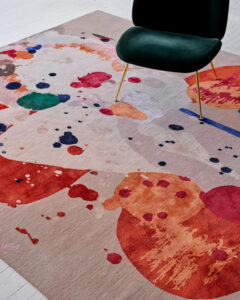
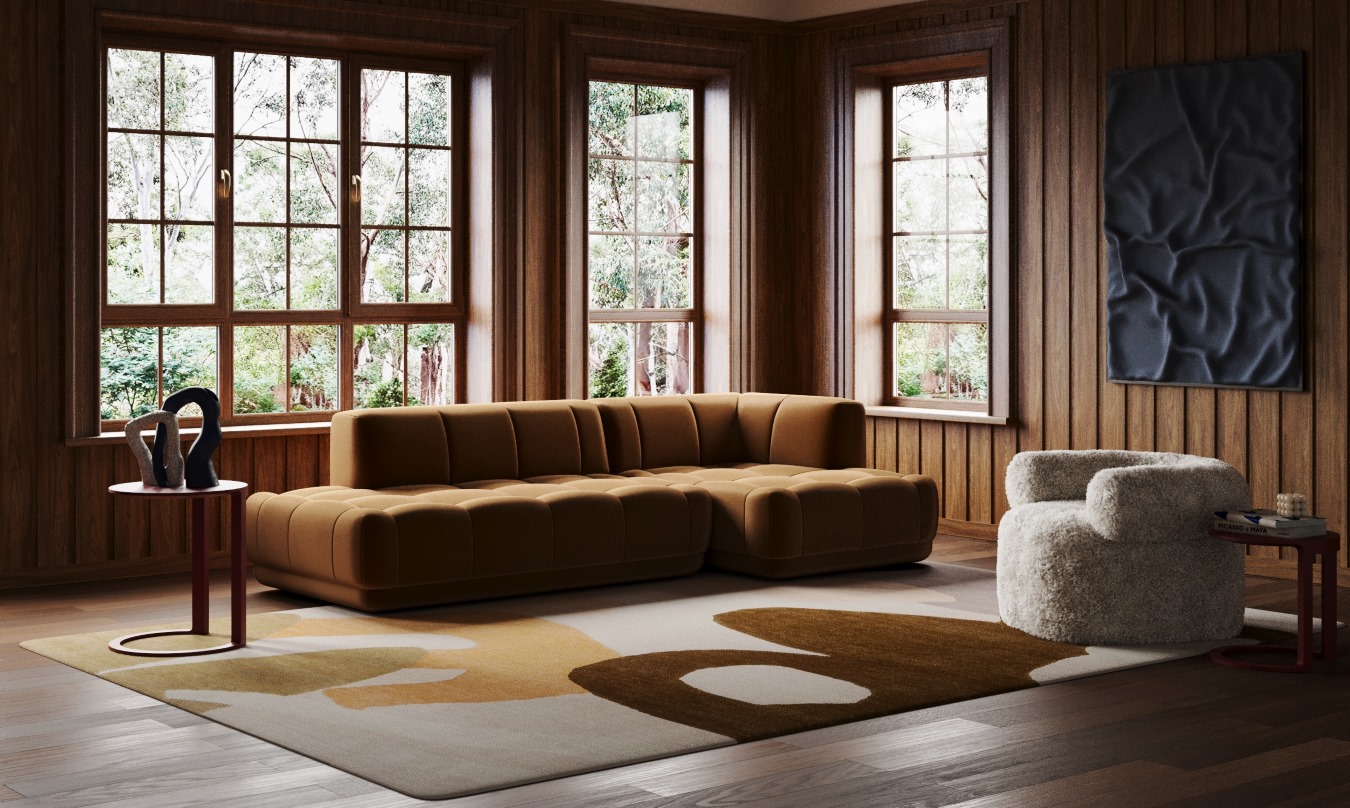
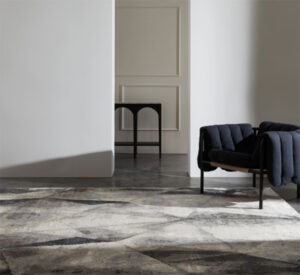
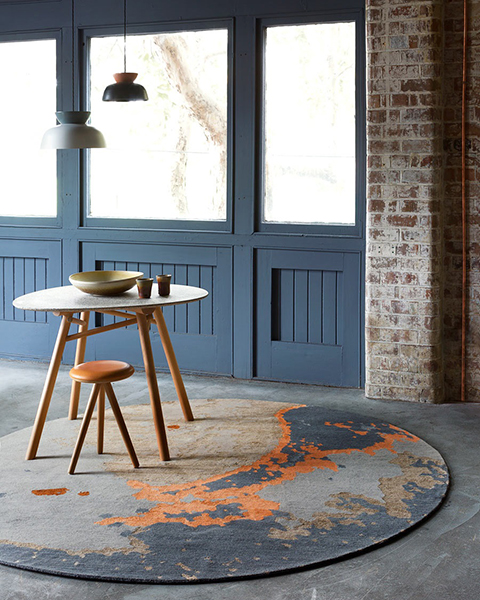
Top image: Grounded rug, Levine Vokaberg. Photo: Pablo Veiga.
Article : Tim Macdonald
Join the Designer Rugs Community
Disclaimer: By signing up, you agree to receive emails & text messages from Designer Rugs, including updates, promotions, and other relevant content. We respect your privacy and will never share your information with third parties. You can unsubscribe at any time by clicking the link at the bottom of our emails.
 1300 802 561
 International Enquiries
 Showrooms